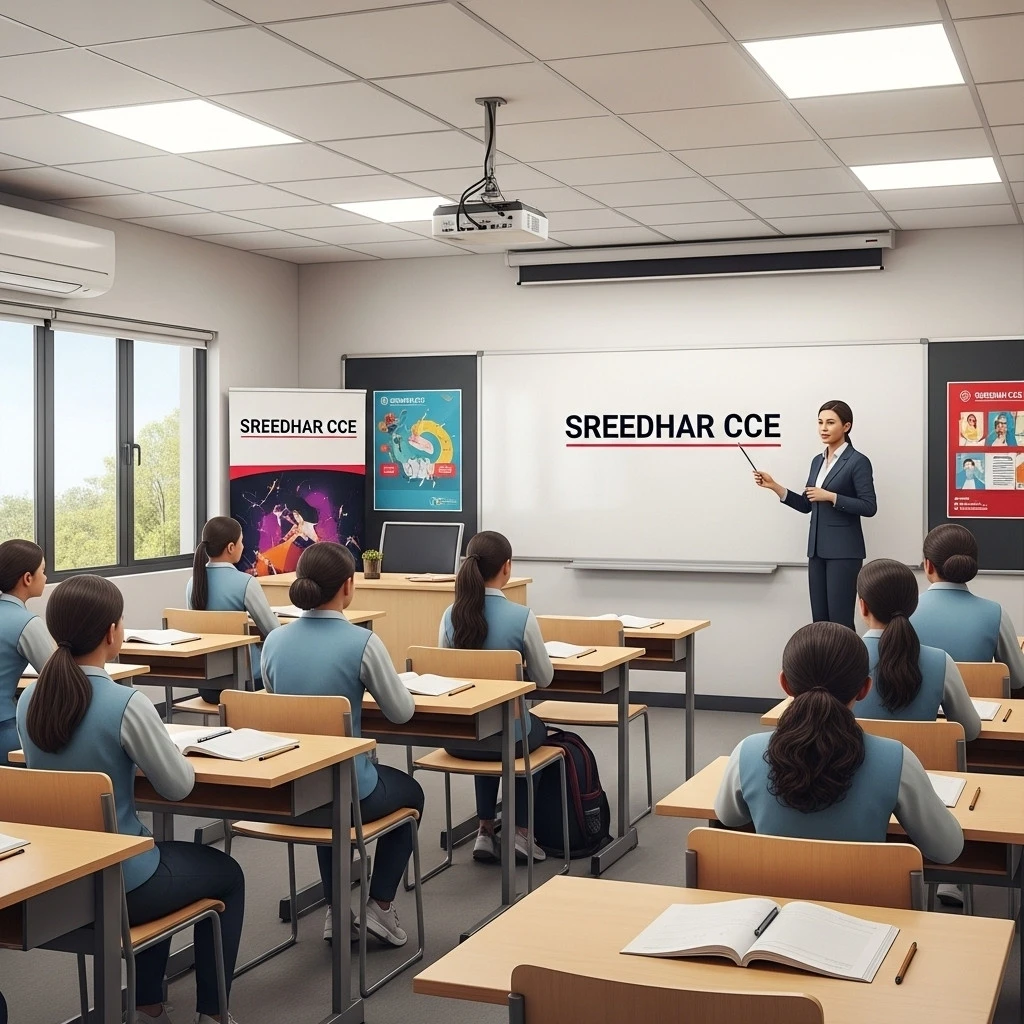
RRB NTPC (Graduate Level) – Complete Exam Guide
Eligibility, Exam Pattern, Syllabus, Cut-Offs, Selection Process & Preparation Strategy
RRB NTPC Overview
The Railway Recruitment Board Non-Technical Popular Categories (RRB NTPC) is a premier national-level competitive examination conducted by the Railway Recruitment Boards (RRBs) to recruit high-caliber candidates for various Graduate-level posts within the Indian Railways. This recruitment drive is vital for the operational and administrative efficiency of one of the world’s largest rail networks.
This examination is widely considered one of the most popular career-entry routes in India because it offers unparalleled job security, a well-defined structured career growth path, competitive salary packages under the 7th Pay Commission, and long-term stability. For many, it represents the pinnacle of a stable government career with prestigious benefits.
Sreedhar’s CCE is a leading name in railway exam coaching, providing aspirants with the edge needed to navigate this highly competitive landscape through proven methodologies and expert guidance.
What Is RRB NTPC and Why Is It Important
The RRB NTPC examination serves as the primary gateway for staffing critical non-technical roles in the Indian Railways. These roles are essential for the day-to-day functioning of passenger and freight services. The purpose of this examination is to ensure a fair, transparent, and merit-based selection of candidates who possess the cognitive abilities and technical skills required to manage complex railway operations.
Roles such as Station Master, Goods Train Manager, and Traffic Assistant are central to the safety and punctuality of trains. Meanwhile, administrative roles like Senior Clerk cum Typist ensure the organizational backbone remains strong. In the larger government sector, RRB NTPC matters because it provides a standardized platform for millions of aspirants to compete based on talent, ensuring that the Indian Railways is managed by a competent and dedicated workforce.
Why RRB NTPC Is a Good Career Choice
Choosing a career through RRB NTPC offers a lifetime of professional growth and personal security. As a central government employee, you are entitled to various allowances, including Dearness Allowance, House Rent Allowance, and travel concessions. The long-term career value is significant, as the Railways provide a clear hierarchy for promotions, allowing a Junior Clerk or Assistant to eventually move into high-level managerial positions through internal examinations and seniority.
Key Advantages
- Job Security: Guaranteed employment under the Central Government with protection against market fluctuations.
- Salary & Allowances: Attractive pay scales with perks like medical facilities for family and pension benefits.
- Work–Life Balance: Regulated working hours and generous leave policies compared to the private sector.
- Promotion & Career Growth: Regular opportunities for departmental promotions to higher grades.
- Social Prestige: Working for the “Lifeline of the Nation” carries immense respect in Indian society.
- Nationwide Postings: The opportunity to work in various parts of India, experiencing diverse cultures.
- Skill Development: Exposure to advanced railway technologies and large-scale administrative systems.
RRB NTPC Eligibility Criteria
The eligibility criteria for RRB NTPC are strictly enforced by the Railway Recruitment Board. Aspirants must meet specific educational and age requirements to participate in the multi-stage recruitment process. Verification of these documents occurs during the final stages, and any discrepancy can lead to immediate disqualification, making it vital for candidates to ensure they meet all norms before applying.
Educational Qualification
- Minimum qualification: A Degree from a recognized University or its equivalent is mandatory for all graduate-level posts.
- Recognized board / university: The degree must be from a government-recognized institution.
- Typing Proficiency: For posts like Junior Accounts Assistant cum Typist and Senior Clerk cum Typist, typing proficiency in English (30 WPM) or Hindi (25 WPM) on a computer is essential.
- Post-Specific Requirements: Certain roles like Station Master and Traffic Assistant require qualifying a specialized Aptitude Test (CBAT).
Age Limit
As per the official information, the standard age bracket for Graduate level posts is 18 to 33 years. However, the government provides age relaxations for reserved categories to ensure inclusive representation in the workforce.
| POST | AGE LIMIT | RELAXATION | |
| Rrb Ntpc Graduate | 18 to 33 years | SC and ST | OBC |
| 5 years | 3 years | ||
RRB NTPC Selection Process
The RRB NTPC recruitment is a comprehensive multi-stage process designed to test a candidate’s speed, accuracy, and psychological fitness for railway duties. The process ensures that only the most capable individuals reach the final merit list. Depending on the post opted for, the number of stages may vary, particularly regarding skill tests or aptitude assessments.
Stages of Selection
- Stage 1: 1st Stage Computer Based Test (CBT) – Common for all posts and primarily used for screening.
- Stage 2: 2nd Stage Computer Based Test (CBT) – Post-specific difficulty levels aimed at final selection scoring.
- Stage 3: Computer Based Aptitude Test (CBAT) for Station Master/Traffic Assistant OR Typing Skill Test (CBTST) for Typist roles.
- Stage 4: Document Verification and Medical Examination to ensure physical fitness for specific categories.
Final selection is based on a combination of CBT 2 scores and, where applicable, the Aptitude Test (70:30 weightage), while the Typing Test remains qualifying in nature.
RRB NTPC Stage 1 Exam Pattern and Syllabus
The Stage 1 CBT is an online objective test that serves as the initial filter. While it is qualifying in nature, the competition is so high that candidates must aim for a high score to ensure they fall within the top percentiles for Stage 2. The exam tests basic mental ability and general awareness, emphasizing the need for quick calculation and a broad knowledge base.
Stage 1 Exam Pattern
| Sections | No. of Questions | Maximum Marks | Time Duration |
| Mathematics | 30 | 30 | 90 Minutes |
| General Intelligence & Reasoning | 30 | 30 | |
| General Awareness | 40 | 40 | |
| Total | 100 | 100 | 90 Minutes |
Key Points
- Negative marking: Yes, 1/3 mark shall be deducted for each wrong answer.
- Sectional cut-offs: As per the available official information, there are no strict sectional cut-offs, but overall merit is key.
- Mode of exam: Online (Computer Based Test).
Syllabus Highlights COMMON (CBT I & CBT II)
SYLLABUS:
- Mathematics:
Number System, Decimals, Fractions, LCM, HCF, Ratio and Proportions, Percentage, Mensuration, Time and Work, Time and Distance, Simple and Compound Interest, Profit and Loss, Elementary Algebra, Geometry and Trigonometry, Elementary Statistics etc.
- General Intelligence and Reasoning:
Analogies, Completion of Number and Alphabetical Series, Coding and Decoding, Mathematical Operations, Similarities and Differences, Relationships, Analytical Reasoning, Syllogism, Jumbling, Venn Diagrams, Puzzle, Data Sufficiency, Statement-Conclusion, Statement- Courses of Action, Decision Making, Maps, Interpretation of Graphs etc.
- General Awareness:
Current Events of National and International Importance, Games and Sports, Art and Culture of India, Indian Literature,
Monuments and Places of India, General Science and Life Science (up to 10th CBSE), History of India and Freedom Struggle, Physical, Social and Economic Geography of India and World, Indian Polity and Governance- constitution and political system, General Scientific and Technological Developments including Space and Nuclear Program of India, UN and Other important World Organizations, Environmental Issues Concerning India and World at Large, Basics of Computers and Computer Applications, Common Abbreviations, Transport Systems in India, Indian Economy, Famous Personalities of India and World, Flagship Government Programs, Flora and Fauna of India, Important Government and Public Sector Organizations of India etc.
Stage 1 Cut-Off Trends
The cut-off for RRB NTPC Stage 1 varies significantly across different RRB zones (e.g., RRB Mumbai vs. RRB Chennai). These trends are influenced by the number of vacancies in a specific zone and the average performance of candidates. Generally, a “Safe Score” strategy involves aiming for 75+ raw marks in most zones to account for normalization shifts.
Trend Analysis
The difficulty level of Stage 1 is usually moderate. However, the sheer volume of applicants (often exceeding 10 million) makes the competition ratio intense. Candidates should focus on the General Awareness section, which carries the highest weightage (40 marks) and can be completed quickly, saving time for the Mathematics and Reasoning sections. Success in Stage 1 is largely about balancing accuracy with the 90-minute time constraint.
RRB NTPC Stage 2 Exam Pattern and Syllabus
Stage 2 is the most critical phase of the recruitment process. The syllabus remains similar to Stage 1, but the difficulty level of questions is significantly higher, and the number of questions increases to 120. This stage determines the candidate’s rank in the final merit list, making every single mark vital for securing a preferred post and location.
Stage 2 Exam Pattern
| Sections | No. of Questions | Maximum Marks | Time Duration |
| Mathematics | 35 | 35 | 90 Minutes |
| General Intelligence & Reasoning | 35 | 35 | |
| General Awareness | 50 | 50 | |
| Total | 120 | 120 | 90 Minutes |
Stage 2 Cut-Off / Merit Analysis
Final merit for RRB NTPC is highly competitive. For non-typing posts like Goods Train Manager, the CBT 2 score is the sole determining factor. For posts requiring a CBAT (Station Master), the CBT 2 score carries 70% weightage. High-scoring subjects like Mathematics and Reasoning are the “rank-makers” because they are objective and scoring, whereas General Awareness acts as the “gatekeeper” due to its vastness.
Final Selection Insights
Tie-breaking rules usually involve the age of the candidate (older candidates ranked higher). Aspirants should prioritize the General Awareness section early in their preparation, as it covers 50 marks in Stage 2. Since there is a negative marking of 1/3, the role of accuracy cannot be overstated; blind guessing often leads to candidates missing the merit list by fractionally small margins.
Final Merit List / Provisional Allotment
The preparation of the final merit list is a meticulous process. After the CBT 2 and subsequent Skill/Aptitude tests, RRB aggregates the scores based on the post-specific weightage rules. Candidates are then called for Document Verification (DV) in a 1:1 ratio based on their merit and preference.
During Document Verification, candidates must produce original educational certificates, caste certificates (if applicable), and identity proofs. Following DV, a medical examination is conducted to ensure the candidate meets the visual and physical standards required for the specific railway post (e.g., A2 medical standard for Station Masters). Provisional allotment is then issued based on the final cleared list and available vacancies in the chosen RRB zone.
Preparation Strategy for RRB NTPC
A successful preparation strategy for RRB NTPC requires a dual focus on speed and conceptual depth. Since the syllabus is vast, especially for General Awareness, candidates should avoid trying to memorize everything and instead focus on high-yield topics. A balanced approach ensures that you don’t neglect the scoring sections of Math and Reasoning while staying updated on current events.
Expert Preparation Tips
- Build conceptual clarity first: Master the basics of Mathematics and Reasoning before attempting shortcuts.
- Practice exam-level questions daily: Solve at least 50–100 questions daily to maintain rhythm.
- Revise current affairs regularly: Focus on the last 12 months of national and international events.
- Take full-length mock tests: Simulate the 90-minute exam environment to manage time effectively.
- Analyse weak areas consistently: Use mock test results to identify and fix recurring mistakes in specific topics like Geometry or Syllogism.
Why Choose Sreedhar’s CCE for RRB NTPC Preparation
Sreedhar’s CCE has established itself as a powerhouse in the field of competitive exam coaching, specifically for Railway and Banking exams. Our institute is built on a foundation of excellence, where we transform aspirants into successful professionals through a result-driven preparation ecosystem. With years of experience in analyzing RRB trends, we provide a roadmap that simplifies the complex syllabus.
Our pedagogy focuses on the unique requirements of the NTPC exam—where speed is just as important as knowledge. We provide our students with an environment that fosters healthy competition, rigorous practice, and constant improvement, ensuring they stay ahead of the millions of other applicants.
Our Competitive Edge
- Expert faculty: Mentors with decades of experience in Railway recruitment patterns.
- Exam-focused material: Updated study kits that cover every nuance of the NTPC syllabus.
- Daily practice & doubt sessions: Immediate resolution of queries to ensure continuous learning.
- Mock tests with analytics: State-of-the-art online testing platform with detailed performance breakdowns.
- Online + Offline options: Flexible learning modes to suit every student’s needs.
How Sreedhar’s CCE Improves Your Selection Probability
At Sreedhar’s CCE, we believe that selection is not a matter of chance but a result of a well-executed system. We improve your selection probability by removing the guesswork from your preparation. Our methodology is designed to identify your specific weaknesses and turn them into strengths through targeted practice and expert intervention. We provide the “Exam Intelligence” that self-study often lacks, giving you a clear understanding of what to study and, more importantly, what to skip.
Structured Learning System
We break down the massive RRB NTPC syllabus into manageable phases: Foundation, Practice, Revision, and Exam Readiness. The Foundation phase ensures you understand the “why” behind every concept. The Practice phase introduces time-bound exercises. As the exam approaches, the Revision and Exam Readiness phases focus on high-speed drills and full-length simulations, preventing the common problem of last-minute panic and ensuring you enter the exam hall with peak confidence.
Exam Intelligence & Trend Analysis
Our dedicated R&D team constantly tracks the evolving nature of Railway exams. We analyze year-on-year changes in question types, shifts in sectional difficulty, and normalization trends across different shifts. This intelligence is integrated into our classroom teaching and study materials. By staying updated with the latest notifications and historical data, we ensure our students are never surprised by the actual exam paper.
Personalized Mentorship & Performance Tracking
Every student at Sreedhar’s CCE undergoes a journey of personalized growth. We don’t just provide marks; we provide insights. Through regular mock analysis and one-on-one feedback loops, we help you identify if you are losing marks due to lack of knowledge, poor time management, or silly mistakes. This granular level of tracking ensures that your preparation graph always moves upward, leading to a much higher probability of clearing the cut-off.
Mock Tests That Simulate Real Exams
Our mock tests are designed to be slightly more challenging than the actual RRB NTPC exam. By practicing in a simulated environment that replicates the real exam interface and time pressure, our students develop the mental stamina required for the 90-minute stretch. We offer full-length mocks for both Stage 1 and Stage 2, along with sectional tests to perfect your performance in Mathematics, Reasoning, and General Awareness individually.
Proven Conversion from Preparation to Selection
The ultimate testimony to our success is our track record. Year after year, Sreedhar’s CCE sees a high conversion rate where students who join our structured programs successfully secure final appointments in the Indian Railways. Our success stories include toppers from various RRB zones, proving that our system works across different regional competition levels. Serious aspirants prefer us because we provide a complete ecosystem—from the first day of coaching to the final interview or skill test.
Frequently Asked Questions (FAQs)
Q1. When should I start preparing for RRB NTPC?
As per the available official information and the high level of competition, the ideal time to start preparing is at least 6 to 8 months before the expected exam date. Given that there are multiple stages, including two levels of CBT and potential skill tests, a candidate needs sufficient time to master the Mathematics and Reasoning fundamentals. Early preparation allows for multiple rounds of revision and the ability to take at least 30–50 full-length mock tests, which are essential for building the speed required to solve 100–120 questions in just 90 minutes.
Q2. Is coaching mandatory to clear this exam?
While self-study is possible, coaching at an institute like Sreedhar’s CCE significantly enhances your efficiency. The RRB NTPC syllabus is vast, and many aspirants struggle with time management and identifying the most important topics. Coaching provides a structured environment, expert shortcuts for mathematical problems, and specialized materials for General Awareness that are hard to compile alone. Furthermore, the competitive atmosphere and regular mock test analysis provided by an institute help in maintaining consistency and tracking progress against thousands of other students, which is difficult to replicate during solo preparation.
Q3. Does the exam have sectional cut-offs?
No, according to the standard RRB NTPC notification rules, there are no specific sectional cut-offs for the Mathematics, Reasoning, or General Awareness sections. Candidates are evaluated based on their total aggregate score in the CBT. However, it is strategically unwise to ignore any section. Since the competition is extremely high, you usually need a high overall score to qualify for the next stage. Relying too heavily on one section while neglecting another (like General Awareness, which has the most questions) can prevent you from reaching the high overall merit threshold required.
Q4. How many hours should I study daily?
For a comprehensive exam like RRB NTPC, a dedicated study plan of 6 to 8 hours daily is recommended. This time should be split into three core activities: 3 hours for learning new concepts or attending classes, 2 hours for practicing previous year’s questions and sectional exercises, and at least 1 hour for daily current affairs and General Awareness revision. As the exam date approaches, the focus should shift toward spending 2–3 hours on a full-length mock test followed by a detailed 2-hour analysis of your performance to identify and correct errors.
Q5. Is there negative marking in both CBT 1 and CBT 2?
Yes, there is a consistent negative marking policy across both the 1st Stage CBT and the 2nd Stage CBT. For every incorrect answer, 1/3 (0.33) of the marks assigned to that question will be deducted. This makes accuracy just as important as speed. Many candidates fail to qualify not because they didn’t know the answers, but because they made too many “blind guesses.” At Sreedhar’s CCE, we train students to develop a calculated approach to answering questions, ensuring they only attempt questions where they have a high level of certainty to protect their total score.
Q6. Can final-year students apply for RRB NTPC Graduate posts?
As per the available official information, candidates must have already obtained their degree from a recognized university by the closing date of the application. The educational qualification is a strict eligibility criterion that is verified during the Document Verification stage. If a candidate’s final result is not declared by the prescribed cutoff date mentioned in the official notification, they are generally not eligible to apply. It is always best to check the specific “Closing Date” in the latest RRB notification to ensure your results are officially declared before that deadline.
Q7. What is the difference between CBT 1 and CBT 2?
The primary difference lies in the difficulty level and the number of questions. CBT 1 consists of 100 questions and acts as a screening test to filter candidates for the next round. CBT 2 is more rigorous, consisting of 120 questions within the same 90-minute time limit, which puts much higher pressure on the candidate’s speed. Furthermore, while CBT 1 is qualifying, the marks obtained in CBT 2 are directly used for the final merit list. Therefore, while Stage 1 requires a broad knowledge base, Stage 2 requires deep expertise and advanced problem-solving skills.
Q8. What are the typing requirements for RRB NTPC?
For specific posts like Senior Clerk cum Typist and Junior Accounts Assistant cum Typist, candidates must pass the Computer Based Typing Skill Test (CBTST). The requirement is a typing speed of 30 words per minute (WPM) in English or 25 WPM in Hindi. This test is conducted on a personal computer without the aid of editing tools or spell-check facilities. It is of a qualifying nature, meaning the marks don’t add to the merit, but you must pass it to remain eligible for those specific posts. We recommend practicing typing daily if you opt for these roles.
Q9. What is the CBAT, and who needs to take it?
The Computer Based Aptitude Test (CBAT) is a specialized psychological and mental ability test mandatory only for those who have opted for the posts of Station Master and Traffic Assistant. It is conducted after the candidate qualifies the 2nd Stage CBT. To pass, candidates must secure a minimum T-Score of 42 marks in each of the “test batteries.” The final merit for these posts is calculated by giving 70% weightage to the CBT 2 marks and 30% weightage to the CBAT marks, making it a crucial stage for selection.
Q10. What medical standards are required for Railway jobs?
Medical standards in the Railways are very strict and vary by post. For example, the Station Master post requires the ‘A2’ medical standard, which includes stringent vision requirements (6/9 vision without glasses) and passing a color vision test. Other administrative posts may have more relaxed ‘C1’ or ‘C2’ standards. Candidates are strongly advised to check the medical requirements for their preferred posts in the official notification before applying, as failing the medical exam at the final stage will result in disqualification regardless of your high CBT scores.
अस्वीकरण
The information provided in this guide is based on previous notifications, historical exam trends, and expert analysis. Candidates are advised to refer to the official notification released by the Railway Recruitment Board (RRB) for the most accurate, updated, and legally binding details regarding vacancies, eligibility, and exam dates.